Daily message / devotional
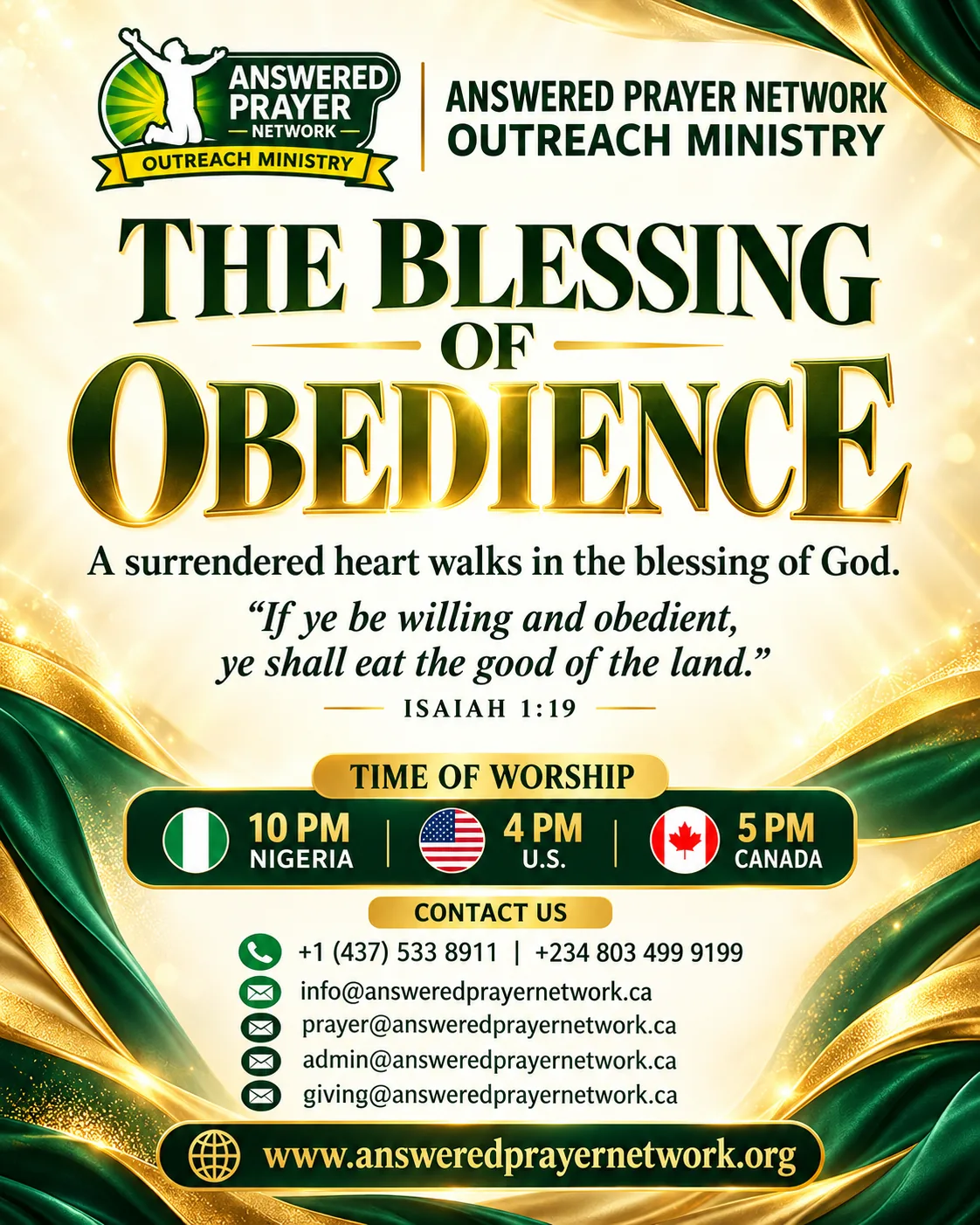
THE BLESSING OF OBEDIENCE
Key Scripture
19 If you are willing and obedient, you will eat the good of the land;Scripture quotations are from the World English Bible (WEB), public domain.
Daily message / devotional
Obedience is the language of a heart surrendered to God. It is the point where our confession of faith becomes a decision, where our love for Christ takes shape in our conduct, and where we allow His Word to govern our desires. Every act of obedience declares: “Lord, Your wisdom is greater than my understanding, and Your will deserves my trust.”
The blessing of obedience reaches deeper than material provision. It touches the conscience, strengthens character, preserves fellowship with God, and produces a life that bears witness to His holiness. An obedient person gives God room to shape what ambition cannot perfect and what religious activity cannot repair.
Jesus said, “If ye love me, keep my commandments.” — John 14:15
These words bring us face to face with the sincerity of our devotion. Love for Jesus reaches into our private choices: how we speak when offended, how we handle money, how we treat those who cannot benefit us, and what we do when nobody is watching. The heart that loves Him learns to honour Him in these places.
We may speak passionately about surrender while protecting an area of disobedience. We may ask God to direct our future while resisting what He has already made clear. Yet spiritual growth requires an honest response to the Word we have received. Before we ask for another instruction, we must consider what we have done with the last one.
“Be ye doers of the word, and not hearers only, deceiving your own selves.” — James 1:22
Hearing the truth carries responsibility. A sermon can move us to tears, but the fruit of that encounter appears in what changes afterward. When God convicts us about dishonesty, obedience requires truthfulness. When He exposes bitterness, obedience requires a willingness to forgive. When He calls us to purity, obedience requires us to address the habits, relationships, and hidden compromises that feed sin.
The blessing begins as His Word takes root in our daily lives.
Saul’s story reveals the danger of trying to cover disobedience with religious activity. After failing to carry out God’s instruction, he offered explanations and referred to sacrifices. Samuel answered:
“Behold, to obey is better than sacrifice, and to hearken than the fat of rams.” — 1 Samuel 15:22
Saul’s actions remind us that worship cannot become an excuse for refusing correction. Giving, fasting, preaching, and serving must flow from a heart willing to submit to God. We cannot knowingly retain what He has commanded us to surrender and expect religious effort to settle the matter.
God receives the worship of a yielded heart. Such a heart can say, “Lord, correct me. Search me. Show me where my actions have contradicted my prayers, and give me grace to respond.”
Obedience also requires trust when the road ahead is unfamiliar. Abraham obeyed God’s call to leave his country without knowing where he was going (Hebrews 11:8). His confidence rested in the One who called him. He took a real step into an uncertain future because he believed God was faithful.
We often desire complete explanations before taking the first step. We want to know how everything will work, who will support us, and how long the journey will take. God’s Word gives us a foundation for trust even when those details remain unknown. As we obey what He has made clear, we learn to depend on Him along the way.
There is a blessing in becoming a person who can trust God without controlling every outcome.
Obedience can also be costly. It may require an apology that wounds our pride, the return of money we obtained dishonestly, or the end of a relationship that continually draws us into sin. It may require us to speak truth when silence would protect our reputation. These decisions can be painful, but they give integrity room to grow.
Zacchaeus demonstrated this when his encounter with Jesus changed his relationship with wealth. He committed himself to generosity and restitution (Luke 19:8–9). His response showed that repentance had reached beyond his words into his responsibilities.
An obedient heart asks, “What must change because I belong to Christ?”
That question can transform a home, a ministry, a business, and a community. It brings accountability into places where excuses have lived for years. It allows repentance to become visible through changed behaviour.
The deepest example of obedience is Jesus Christ. In Gethsemane, facing the suffering of the cross, He prayed:
“Nevertheless not my will, but thine, be done.” — Luke 22:42
His surrender reveals the sacred depth of obedience. He remained faithful through anguish, rejection, and suffering. Philippians 2:8–11 describes His obedience unto death and the exaltation that followed.
We must therefore understand that obedience does not promise a life without hardship. Faithful believers can experience persecution, grief, delay, and loss. Their suffering does not prove that God has abandoned them. Christ’s own life teaches us that obedience can lead through painful places while remaining fully within the Father’s will.
The blessing is that suffering cannot make faithfulness meaningless. God sees the surrender that others overlook. He knows the cost of doing right when doing wrong would have been easier.
Jesus illustrated the strength of obedience through the man who built his house upon a rock (Matthew 7:24–27). The rain descended, the floods came, and the winds blew. The house stood because its foundation was secure.
Notice that the obedient man still faced the storm.
Obedience builds a foundation capable of sustaining us through pressure. God’s truth steadies our decisions when fear rises. Integrity protects us from the complications of deceit. Forgiveness frees us from continually feeding resentment. Faithfulness teaches us to endure beyond the excitement of a beginning.
These are profound blessings. A clean conscience, a steadfast heart, and a life grounded in truth are treasures that outward success cannot replace.
Obedience also deepens our fellowship with God. Jesus connects love, keeping His Word, and the Father’s presence in John 14:23. As we receive His teaching and live by it, our lives increasingly reflect the One we follow.
This obedience is our response to His grace. Salvation is God’s gift, received through faith, and we are created in Christ Jesus for good works (Ephesians 2:8–10). We depend upon the Holy Spirit to strengthen us. When we stumble, we return to God in repentance and receive His forgiveness. We allow His mercy to restore us and His truth to direct our next step.
A surrendered heart remains teachable.
We must also examine what we call obedience. God’s authority must never become a covering for human manipulation. Scripture teaches us to obey God above people (Acts 5:29). Any instruction that demands wrongdoing must be tested against His Word. Spiritual maturity includes discernment, honesty, and accountability.
The call to obedience is therefore a call to walk closely with Christ: to know His Word, receive His correction, and follow His ways.
Beloved, bring before God the area you have been avoiding. Speak the truth you have postponed. Make the apology you owe. Address the compromise you have excused. Fulfil the responsibility you have neglected. Let your prayers become a sincere invitation for God to govern your life.
You do not need to wait until obedience feels easy. Ask for grace, and take the faithful step before you.
The blessing of obedience is a life increasingly shaped by the wisdom, holiness, and love of God. It is the strength to remain faithful under pressure, the freedom of walking in truth, and the joy of knowing that your life is yielded to Christ.
Let this be the answer of your heart:
“Father, make me willing where I have resisted You. Make me faithful where I have compromised. Let Your Word govern my choices, and let my life bear the fruit of obedience to You.