Daily message / devotional
THE IDOLS WE HIDE IN OUR HEARTS
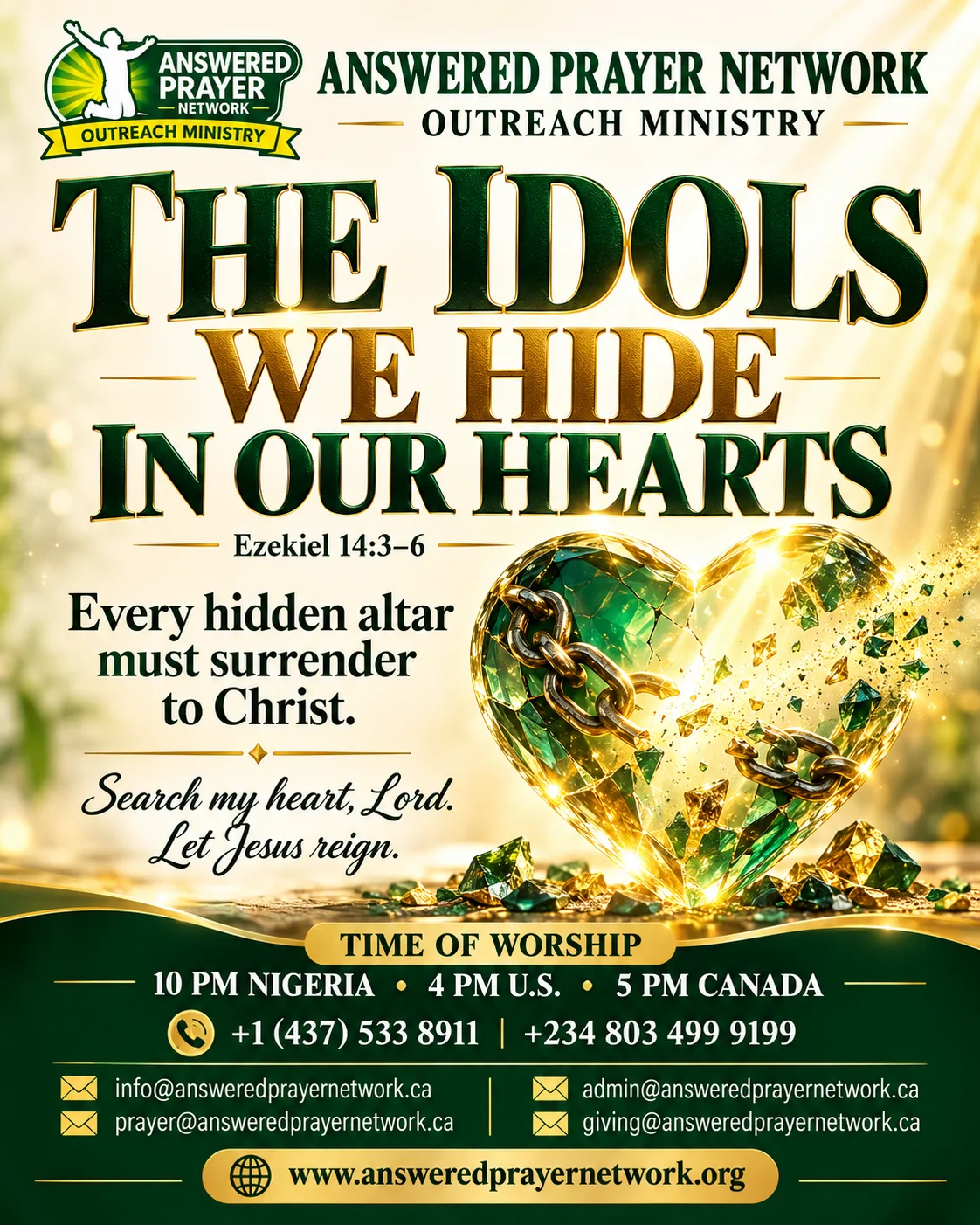
Key Scripture
3 “Son of man, these men have taken their idols into their heart, and put the stumbling block of their iniquity before their face. Should I be inquired of at all by them?Scripture quotations are from the World English Bible (WEB), public domain.
Daily message / devotional
The heart can carry an altar that nobody else can see. A person may speak the language of faith, attend every prayer meeting, and serve faithfully in church while quietly giving something else the highest place in their life. Our lips can declare that Jesus is Lord while our decisions reveal another master.
In Ezekiel 14, the elders of Israel came before the prophet to seek God. Yet God addressed what they had brought within them: idols established in their hearts. Their outward appearance suggested spiritual interest, but God saw the loyalties beneath it.
God sees the throne of the heart, and He knows what occupies it.
An idol is anything we give the authority, devotion, or ultimate trust that belongs to God. Money, relationships, influence, success, and even ministry can become idols when we surrender our obedience to preserve them. Something good can become spiritually dangerous when we give it the right to govern our conscience.
The question reaches deeper than what we possess. What possesses us? What has become so important that we would disobey God to obtain it, compromise our integrity to protect it, or abandon our convictions to keep it?
Jesus said that where our treasure is, there our heart will be also (Matthew 6:21). Our priorities leave evidence. They appear in the choices we defend, the sacrifices we make, and the instructions from God we keep postponing.
One of the most carefully concealed idols is the desire for human approval.
We want acceptance. We want people to understand us, appreciate us, and speak well of us. Those desires become a spiritual snare when the opinions of people begin to determine our obedience. We soften truth to avoid rejection. We remain silent when conscience calls us to speak. We agree to things that trouble our spirits because we fear losing our place in someone’s life.
Saul admitted that he had sinned because he feared the people and obeyed their voice (1 Samuel 15:24). His confession exposes a struggle that still confronts believers: the voice we fear most often becomes the voice we obey.
We must examine whose displeasure controls our decisions.
Another hidden idol is the need to remain in control.
We pray for God’s direction while insisting that His answer must fit our timetable. We ask Him to lead while holding tightly to the outcome. We become unwilling to obey unless we can first understand every consequence.
Faith calls us to trust God with what we cannot arrange. Planning has its place, and wisdom requires responsibility. Yet our plans must remain open to the Lord’s correction. A heart surrendered to God can say, “Father, this is what I desire, and I place it under Your will.”
Jesus demonstrated that surrender in Gethsemane: “Nevertheless not my will, but thine, be done” (Luke 22:42).
That prayer reaches into the deepest part of discipleship. It places our desires before the Father and gives Him authority over them.
For some, the hidden idol is money or the security it promises.
The rich man who approached Jesus appeared sincere. He asked about eternal life and spoke of keeping the commandments. When Jesus addressed his attachment to wealth, he went away sorrowful because he had great possessions (Mark 10:17–22).
His sorrow revealed the strength of his attachment. He desired what Jesus offered, yet he struggled to release what already held his heart.
We can face the same conflict whenever financial advantage begins to overrule honesty, generosity, or obedience. Money becomes a master when we trust it to give us the worth and security that we seek from God.
The blessing must remain beneath the authority of the Blesser.
Even ministry can become an idol.
A person may begin with a sincere desire to serve God and gradually become consumed by recognition, titles, influence, or being needed. Correction begins to feel like humiliation. Another person’s progress becomes a threat. Service becomes a way to protect a reputation.
This calls for honest examination, especially among those entrusted with spiritual responsibility. Can we receive correction? Can we celebrate another person’s usefulness? Can we serve faithfully when our names are absent and our efforts receive little attention?
The work of God requires a heart willing to remain under the authority of God.
Relationships can also take a place that belongs to Him. Loving a spouse, child, friend, or family member is a precious responsibility. Yet no relationship should require us to surrender our conscience or participate in wrongdoing. Faithful love seeks another person’s good while remaining answerable to Christ.
Sometimes we hide an idol behind the sentence, “I cannot live without this.”
Grief, disappointment, and longing are human experiences, and they deserve compassion. The spiritual danger appears when we give a person, possession, or desired outcome the final authority to define our worth and direct our lives. Our deepest identity must remain rooted in the God who made us and the Christ who redeemed us.
Hidden idols often become visible when they are challenged.
Correction exposes our attachment to pride. Another person’s success can expose our hunger for recognition. An opportunity to gain through dishonesty can expose our dependence on money. A clear instruction from Scripture can reveal the desire we have placed above obedience.
These moments give us an opportunity to bring our hearts into the light.
We need the honesty of the psalmist: “Search me, O God, and know my heart” (Psalm 139:23). This prayer requires a willingness to receive what God reveals. We cannot ask Him to search us while defending every attachment He touches.
In Ezekiel 14:6, God called His people to repent and turn from their idols. His command opened a way back to Him. The exposure of sin carried an invitation to restoration.
Repentance must reach our choices. If approval has become our idol, we must practise obedience even when people misunderstand. If money has become our master, we must restore honesty and generosity. If pride rules us, we must receive correction and make necessary apologies. If control governs us, we must entrust our plans to God and obey the direction He gives.
Whatever we confess before God, we must also stop protecting in our daily lives.
Christ gives us both the mercy to return and the grace to change. We can approach Him honestly, acknowledging the loyalties we have concealed and asking Him to reorder our desires. His love gives us courage to surrender.
Today, let us examine the places we have kept beyond His authority. Let us bring Him the ambition we defend, the approval we chase, the bitterness we nourish, and the outcome we insist upon.
May our worship reach into our conduct. May our prayers produce obedience. May our private loyalties agree with our public confession.
Let Jesus have the highest place in the heart, and let every decision bear witness to His lordship.