Daily message / devotional
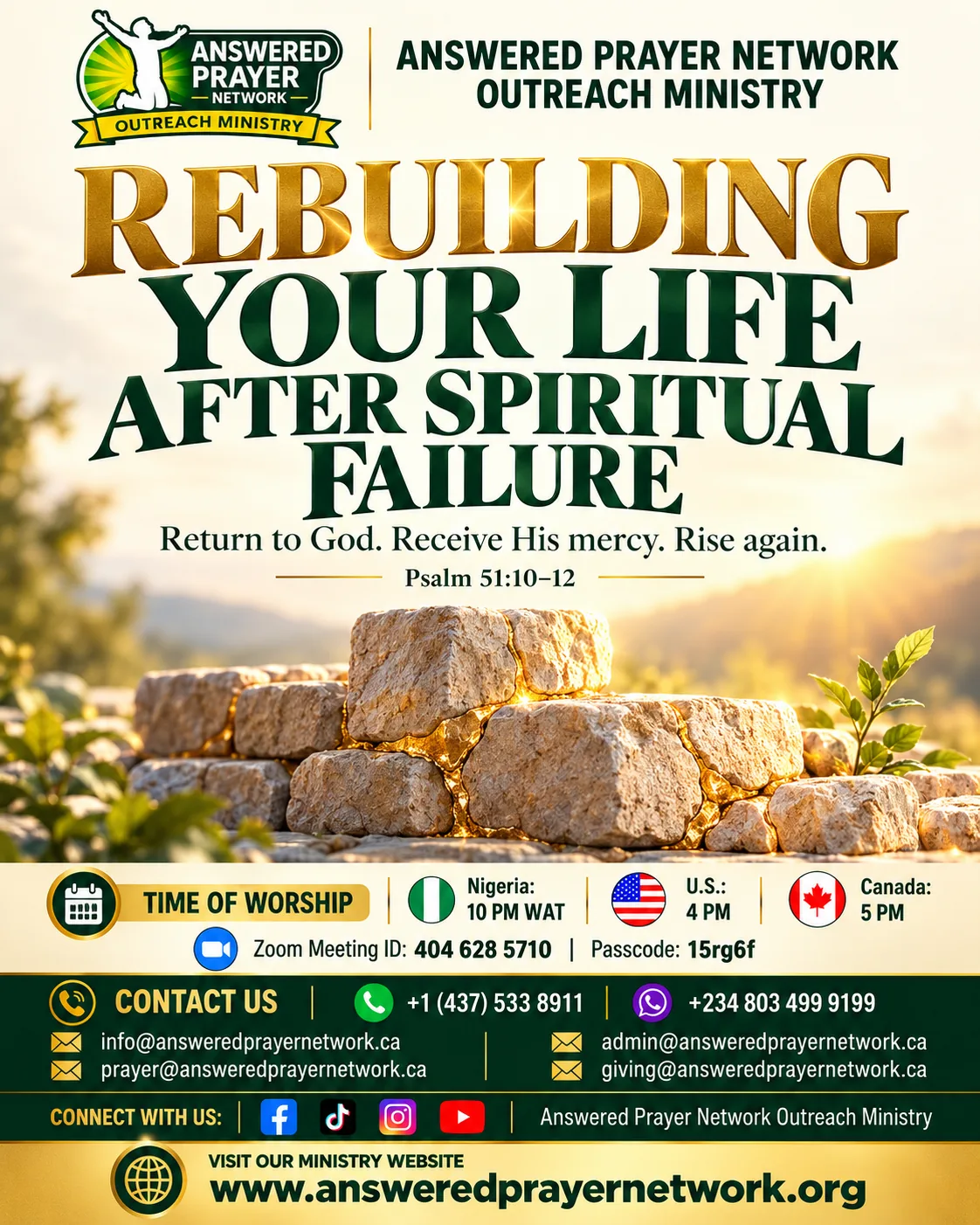
REBUILDING YOUR LIFE AFTER SPIRITUAL FAILURE
Key Scripture
54 They seized him and led him away, and brought him into the high priest’s house. But Peter followed from a distance. 55 When they had kindled a fire in the middle of the courtyard and had sat down together, Peter sat among them. 56 A certain servant girl saw him as he sat in the light, and looking intently at him, said, “This man also was with him.” 57 He denied Jesus, saying, “Woman, I don’t know him.” 58 After a little while someone else saw him and said, “You also are one of them!” But Peter answered, “Man, I am not!” 59 After about one hour passed, another confidently affirmed, saying, “Truly this man also was with him, for he is a Galilean!” 60 But Peter said, “Man, I don’t know what you are talking about!” Immediately, while he was still speaking, a rooster crowed. 61 The Lord turned and looked at Peter. Then Peter remembered the Lord’s word, how he said to him, “Before the rooster crows you will deny me three times.” 62 He went out, and wept bitterly.Scripture quotations are from the World English Bible (WEB), public domain.
Daily message / devotional
Peter had promised that he would stand with Jesus, even if it cost him his life. Yet before the night was over, he had denied knowing the very Lord he claimed he would never abandon. When the rooster crowed and Jesus turned to look at him, Peter went out and wept bitterly (Luke 22:54–62).
Those tears carried the weight of a broken promise.
Perhaps you understand that kind of sorrow. You remember how sincerely you once prayed, how firmly you stood, and how confidently you believed you would never return to certain habits. Then you fell. You compromised a conviction, neglected your walk with God, wounded someone, or concealed something you should have brought into the light.
Now the hardest struggle may be coming before God again. You open your Bible and feel accused by your own conscience. You try to pray, but the memory of what happened interrupts every sentence.
The gospel speaks directly into that place. Through Jesus Christ, forgiveness and restoration remain available to the person who turns back to God. Your failure must be faced honestly, but it does not have to become the permanent direction of your life.
Rebuilding begins when you stop hiding.
After Adam sinned, he hid among the trees. That instinct still operates in the human heart. We hide behind explanations, religious activity, silence, and the fear of what others might discover. Sometimes we even hide behind spiritual language, calling everything an attack while refusing to acknowledge our own choices.
Whatever temptation surrounded you, repentance requires you to take responsibility for what you did.
God already knows the truth. You do not have to prepare a speech that makes your conduct sound less serious. Bring Him the facts. Name the sin. Admit the damage. Acknowledge the compromises that made room for it.
Proverbs 28:13 connects mercy with confessing and forsaking sin. Confession opens the wound to the healing work of God; forsaking sin begins the necessary change in direction.
A life cannot be rebuilt securely while deception remains in its foundation.
David understood the need for inward cleansing. After his sin was exposed, he asked God for a clean heart and a renewed spirit (Psalm 51:10). His prayer reached beyond the immediate disgrace to the condition within him that had allowed such wrongdoing.
That is a prayer worth praying with complete sincerity: “Lord, deal with the heart that produced this failure.”
Let repentance become visible in your decisions.
Deep emotion can accompany repentance, but emotion alone cannot carry the work of rebuilding. The direction of your life must change.
If a relationship keeps drawing you into compromise, establish a firm boundary. If secrecy has protected a sinful habit, seek wise and trustworthy accountability. If pride has made you impossible to correct, learn to receive correction without defending yourself. If you have harmed someone, acknowledge it and make appropriate efforts to repair the damage.
The person you hurt may need time. Trust may return slowly. Some consequences may remain even after forgiveness has been received.
Accepting those realities is part of spiritual maturity. You cannot demand that others recover at the speed you prefer. Give them room, honour their boundaries, and allow consistent conduct to speak over time.
God’s mercy gives you the courage to face responsibility.
Receive forgiveness without continuing to punish yourself.
There is a sorrow that leads a person toward repentance, and there is a sorrow that drains the desire to keep living faithfully. Scripture distinguishes between these in 2 Corinthians 7:10.
Pay attention to where your sorrow is taking you.
Conviction brings a particular sin into the light so that you can confess it and turn from it. Despair spreads over your entire identity until you begin to believe that nothing good can ever grow in your life again.
When you have confessed your sin and turned to Christ, trust His promise of forgiveness and cleansing (1 John 1:9). You honour His word by believing that His mercy applies to you.
Endless self-accusation cannot accomplish what the blood of Jesus has already accomplished. You cannot earn forgiveness by remaining miserable long enough. Receive grace with humility, gratitude, and a renewed commitment to obedience.
Return to the quiet disciplines that strengthen your soul.
A weakened spiritual life needs patient attention.
Begin praying again, even when your words feel small. Read Scripture slowly enough to receive its correction. Return to fellowship with believers who will care for you honestly. Keep the commitments you make. Practise obedience in the ordinary decisions that nobody applauds.
Rebuilding often happens quietly.
It happens when you tell the truth although a lie would protect your image. It happens when you close the door to temptation before desire gains strength. It happens when you accept correction, keep a boundary, and choose prayer over avoidance.
These decisions matter. Through them, your daily conduct begins to agree with the repentance you have expressed.
Do not rush to recover a position while neglecting the recovery of your character. Where leadership has been compromised, allow proper accountability and time for discernment. The health of your soul and the wellbeing of those you serve deserve careful attention.
Allow Christ to address the place where you broke.
In John 21, the risen Jesus met Peter and asked him about his love. Peter’s denial was part of his history, and Jesus dealt with him personally. The Lord also entrusted him with the responsibility of caring for His sheep.
Before Peter’s failure, Jesus had already spoken of praying for him and of the strengthening work he would do after he returned (Luke 22:31–32).
What mercy. Christ knew Peter’s weakness before Peter fully understood it.
That same Lord calls you to return with honesty. You do not have to manufacture an impressive version of yourself before approaching Him. Come with your grief, your responsibility, and your willingness to be changed.
Your past requires truth. Your present requires obedience. Your future requires trust in the God who restores.
Get up, and take the next faithful step.
Let the lesson deepen your humility. Let forgiveness renew your gratitude. Let accountability strengthen your integrity. Let your restored fellowship with God become more precious than the appearance of spiritual strength.
The Saviour you failed is the Saviour to whom you can return.
Come back to Him. Bring everything into the light. Then build, day by day, upon His word.