Daily message / devotional
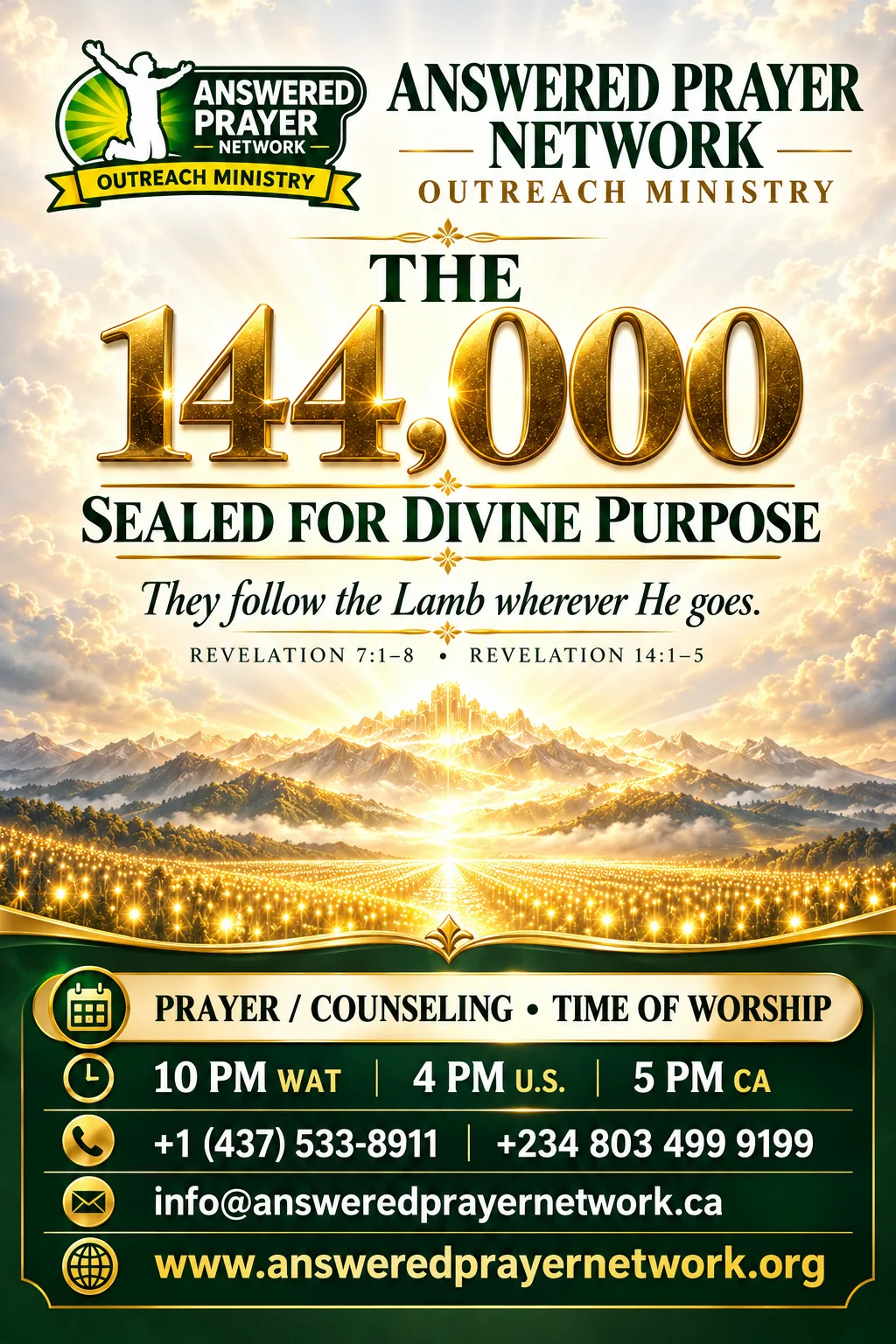
The 144,000: Sealed for Divine Purpose
Key Scripture
1 After this, I saw four angels standing at the four corners of the earth, holding the four winds of the earth, so that no wind would blow on the earth, or on the sea, or on any tree. 2 I saw another angel ascend from the sunrise, having the seal of the living God. He cried with a loud voice to the four angels to whom it was given to harm the earth and the sea, 3 saying, “Don’t harm the earth, the sea, or the trees, until we have sealed the bondservants of our God on their foreheads!” 4 I heard the number of those who were sealed, one hundred forty-four thousand, sealed out of every tribe of the children of Israel: 5 of the tribe of Judah twelve thousand were sealed, of the tribe of Reuben twelve thousand, of the tribe of Gad twelve thousand, 6 of the tribe of Asher twelve thousand, of the tribe of Naphtali twelve thousand, of the tribe of Manasseh twelve thousand, 7 of the tribe of Simeon twelve thousand, of the tribe of Levi twelve thousand, of the tribe of Issachar twelve thousand, 8 of the tribe of Zebulun twelve thousand, of the tribe of Joseph twelve thousand, and of the tribe of Benjamin twelve thousand were sealed.Scripture quotations are from the World English Bible (WEB), public domain.
Daily message / devotional
Before the winds of judgment are released, heaven gives a command: the servants of God must be sealed. John hears their number—144,000 from the tribes of Israel. The vision begins with a truth that should steady every believer’s heart: God knows those who belong to Him, and His purposes will not be lost in the turmoil of the earth.
A seal declares ownership. It identifies those who belong to another. In Revelation, the seal is placed on the foreheads of God’s servants; when John sees the 144,000 again, they stand with the Lamb on Mount Zion, bearing the names of the Lamb and His Father. The defining glory of this company is whose name they carry—and whom they stand beside.
They are sealed before the crisis unfolds. God’s knowledge of His servants does not begin when danger appears. Heaven does not discover them in the confusion and then struggle to preserve them. The command to seal them comes before the winds are released. What God has purposed, He is able to identify and keep.
Yet the seal should not be turned into a promise that faithful people will never face hardship. Revelation calls God’s people to endurance. Divine keeping means that suffering and opposition cannot cancel God’s claim upon those who are His. The world may challenge their faithfulness, but it cannot erase the name of the Lamb.
They are called to faithful allegiance. Revelation 14 describes the 144,000 as those who follow the Lamb wherever He goes. Their lives are marked by devotion, truthfulness and worship. They do not choose loyalty to Christ only when obedience is easy. They remain His when the pressure to compromise is strong.
This is the spiritual weight of being sealed for divine purpose: to bear God’s name is to answer His call with one’s life. A holy identity calls for a holy response. A mouth that praises the Lamb must also speak truth. A heart that belongs to Him must resist the idols that demand its worship.
The Lamb is the centre of the vision. The 144,000 are never presented as a people who made themselves worthy by their own strength. Revelation describes them as redeemed, and John sees them with the Lamb. Their song, their standing and their future are bound to Him. Their victory draws its meaning from His victory.
Christians understand the identity of the 144,000 in different ways. Some read the number as a literal group drawn from the tribes of Israel; others understand it symbolically within Revelation’s imagery. The passage names the tribes, and the wider chapter also shows a multitude from every nation standing before the Lamb. We should handle those details with care and avoid claiming certainty where faithful readers differ. The clear call of the vision remains: God knows His people, and the Lamb is worthy of their complete allegiance.
The question this passage places before us is therefore deeper than curiosity about a number: Whose name governs my life? Revelation shows a world in which allegiance is contested. The beast demands submission; the Lamb calls people to follow Him. The sealed company stands as a witness that even under fierce pressure, worship can remain faithful and truth can remain on the lips of God’s people.
Every Christian should also hear the personal call to belong wholly to Christ. Paul writes that those who hear and believe the gospel are sealed with the promised Holy Spirit (Ephesians 1:13–14). That teaching gives believers a reason to live with reverence, confidence and fidelity to the One who has claimed them.
The final picture is powerful: after the sealing, after the conflict, John sees the Lamb standing—and the 144,000 with Him. Their purpose reaches its fullness in His presence. May we seek that same steadfast devotion: to know the voice of the Lamb, to follow Him when obedience costs us something, and to stand faithful under His name.