Daily message / devotional
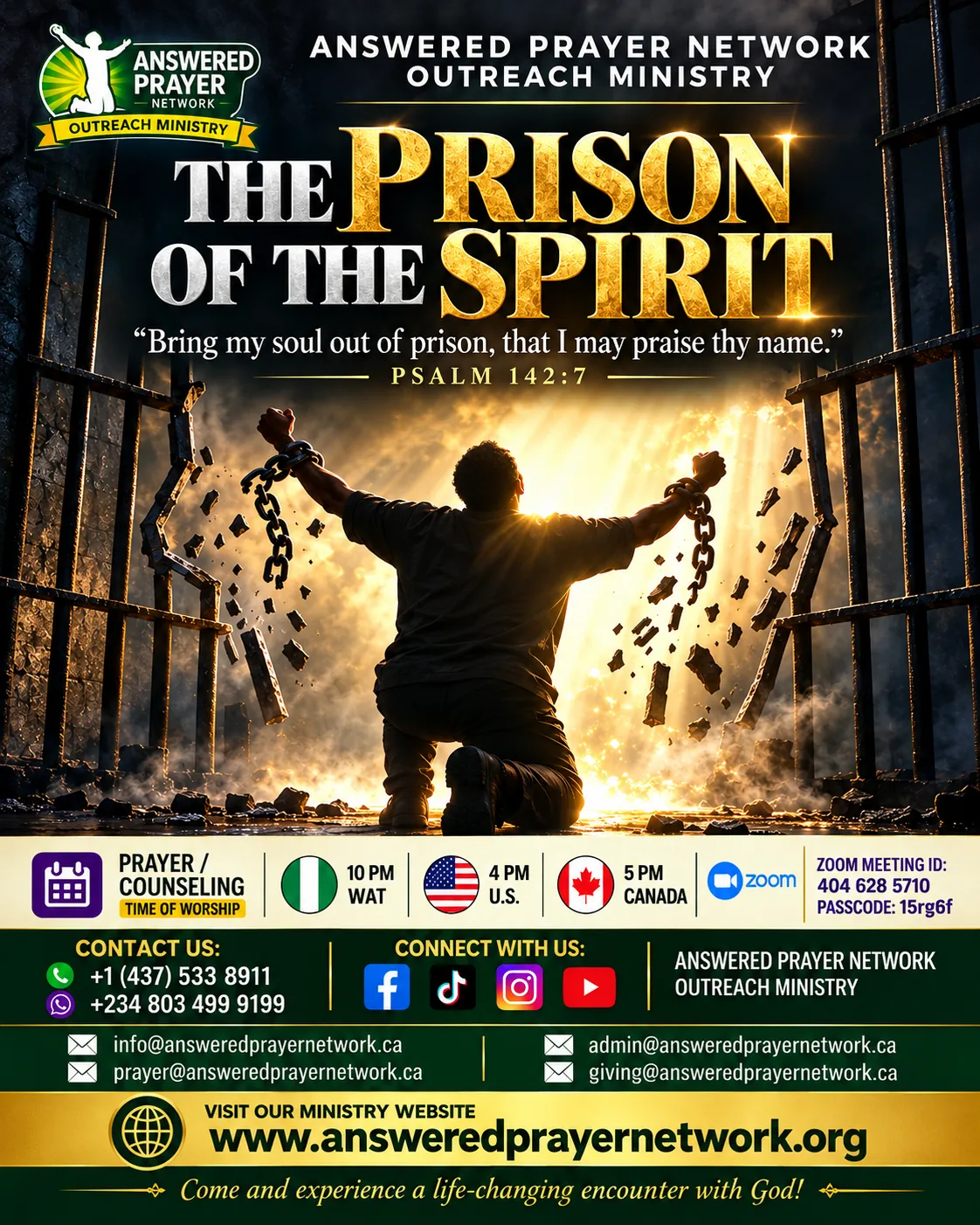
THE PRISON OF THE SPIRIT
Key Scripture
[7] Bring my soul out of prison, That I may praise Your name; The righteous shall surround me, For You shall deal bountifully with me.”New King James Version®, Copyright© 1982, Thomas Nelson. All rights reserved.
Daily message / devotional
The most dangerous prisons are not always built with iron bars, guarded gates, or concrete walls. Some prisons are invisible. A person may walk freely, speak confidently, attend church faithfully, and still carry chains within the soul. The body may be moving, yet the inner person remains confined by fear, guilt, bitterness, trauma, condemnation, secret sin, or spiritual oppression.
The Holy Spirit cannot be imprisoned, but the human spirit can become wounded, burdened, and restricted. When this happens, a person may possess great potential yet remain unable to rise. They may receive opportunities but lack the courage to embrace them. They may be surrounded by love but remain unable to receive it. They may hear the promises of God but struggle to believe those promises apply to them.
This is the prison of the spirit: an inward captivity that limits a person’s ability to live, love, worship, hope, and fulfil divine purpose.
An Invisible Captivity
Physical prisons restrict movement, but spiritual prisons restrict destiny. They imprison the mind in yesterday, the emotions in pain, and the heart in fear. They convince a person that change is impossible, restoration is too late, and freedom belongs to everyone except them.
Some people escaped the place where they were wounded, but the wound never left them. They changed locations, relationships, churches, or careers, yet the same fear continued to follow them. The environment changed, but the inward prison remained.
Israel physically left Egypt, but Egypt did not immediately leave their minds. Although Pharaoh was behind them, the mentality of slavery travelled with them. They had crossed the Red Sea, yet fear, complaining, unbelief, and dependence on the familiar continued to control their decisions.
Deliverance is not complete merely because the external enemy has disappeared. True freedom comes when the chains within the heart are also broken.
The Walls of the Prison
Every spiritual prison has walls, and these walls are often built gradually.
The Wall of Fear
Fear imprisons the spirit by magnifying danger and minimizing the power of God. It makes a person afraid to begin again, trust again, love again, or pursue purpose again. Fear continually asks, “What if you fail?” Faith answers, “What if God goes before you?”
God has not given us the spirit of fear, but of power, love, and a sound mind (2 Timothy 1:7). Fear may knock at the door, but it must never be permitted to become the ruler of the house.
The Wall of Condemnation
Conviction leads a person toward repentance and restoration, but condemnation continually pushes them away from God. Condemnation says, “You have failed; therefore, you are finished.” Grace says, “You have fallen; now arise and return to God.”
Many believers have confessed their sins, yet they continue to punish themselves for what God has already forgiven. They remain imprisoned by memories of who they used to be. But Romans 8:1 declares that there is no condemnation for those who are in Christ Jesus.
The blood of Jesus does not merely hide sin; it cleanses, restores, and gives the repentant believer a new identity.
The Wall of Unforgiveness
Unforgiveness is a prison in which the offended person remains chained to the one who caused the pain. The offender may have moved on, yet the wounded person continues to relive the injury.
Forgiveness does not mean that the offence was acceptable. It does not always require restored access, removed boundaries, or renewed trust. Forgiveness means surrendering vengeance to God and refusing to allow another person’s wrongdoing to continue ruling your heart.
Bitterness promises protection, but it produces imprisonment. Forgiveness may not change the past, but it releases the future.
The Wall of Secret Sin
Sin first appears as pleasure, permission, or personal freedom, but its final intention is control. What a person initially chooses can eventually begin to command them.
Secret sin weakens spiritual sensitivity. It steals boldness in prayer, disturbs peace, and creates distance in fellowship with God. The enemy uses secrecy to deepen captivity, but God uses confession and repentance to open the prison door.
Whoever conceals sin cannot prosper spiritually, but the one who confesses and forsakes it receives mercy (Proverbs 28:13).
The Wall of Wounded Memories
Words spoken many years ago can become bars around the spirit. Rejection, betrayal, abandonment, humiliation, abuse, or repeated disappointment can teach the heart to expect pain.
A wounded spirit may smile publicly while bleeding privately. It may interpret correction as rejection, love as manipulation, and silence as abandonment. This is why healing must reach beyond outward behaviour and touch the hidden places of the heart.
Jesus does not shame the wounded. He binds up the brokenhearted and restores those whose strength has been crushed (Psalm 147:3; Isaiah 61:1).
Signs of an Imprisoned Spirit
An imprisoned spirit may reveal itself through persistent hopelessness, fear of progress, isolation, self-sabotage, uncontrolled anger, inability to forgive, loss of spiritual hunger, constant expectation of failure, or resistance to genuine love.
A person may repeatedly return to what harms them because bondage has made captivity feel familiar. Freedom may even feel uncomfortable because it requires a new way of thinking, believing, and living.
The prison will often speak through thoughts such as:
“You will never change.”
“No one can truly love you.”
“Your past has destroyed your future.”
“God has abandoned you.”
“You are too damaged to be useful.”
These are not the verdicts of heaven. They are voices of captivity. God’s truth must become louder than every lie that has occupied the mind.
Jesus, the Breaker of Spiritual Prisons
Jesus did not come merely to make imprisoned people comfortable. He came to proclaim liberty to the captives and open the prison doors to those who are bound (Isaiah 61:1; Luke 4:18).
At the cross, Jesus confronted sin, shame, condemnation, death, and every power that held humanity captive. Through His resurrection, He demonstrated that no grave, prison, seal, or spiritual authority could prevent the purpose of God from being fulfilled.
When the Son makes a person free, that freedom is real and complete (John 8:36). Christ does not only break the chain; He heals the wounds the chain created. He restores identity, renews the mind, and teaches the liberated person how to walk in freedom.
When Praise Enters the Prison
Paul and Silas were physically imprisoned, but their spirits remained free. At midnight, they prayed and sang praises to God. Suddenly, the prison foundations were shaken, the doors opened, and everyone’s chains were loosened (Acts 16:25–26).
Their bodies were confined, but their worship could not be imprisoned.
The enemy may attack circumstances, but he must not be allowed to silence worship. Praise reminds the soul that God is greater than the prison. Prayer invites divine power into places where human strength has failed. The presence of God reaches beyond every locked door.
Sometimes God removes His people from the prison. At other times, He enters the prison and reveals that the prison cannot remove His presence from them.
The Journey into Freedom
Freedom begins with truth. A person must courageously acknowledge what has been controlling the heart. What remains hidden often remains powerful, but what is brought into the light can be confronted and healed.
Repent where repentance is needed. Forgive where bitterness has taken root. Reject every lie that contradicts the Word of God. Seek wise pastoral counsel, professional support, or medical care where deep emotional wounds and mental-health struggles are involved. Receiving appropriate help is not a failure of faith; it can be part of God’s pathway to healing.
Renew the mind daily through Scripture. Pray honestly. Worship intentionally. Establish healthy boundaries. Remain connected to mature believers. Walk in obedience, even when emotions have not yet caught up with truth.
Freedom is sometimes experienced in a powerful moment, but it must also be defended through daily surrender. Galatians 5:1 commands believers to stand firm in the liberty Christ has provided and refuse to become entangled again with bondage.
Do not return emotionally to what God has delivered you from spiritually.
Come Out of the Prison
God is calling His people out of every invisible prison. He is breaking the prison of fear, silencing condemnation, healing wounded memories, uprooting bitterness, and destroying the power of secret sin.
Your history does not have the authority to cancel God’s purpose. What happened to you may explain your wounds, but it does not have to determine your future. The place where you were once imprisoned can become the place from which your testimony is born.
The Lord is entering the deepest chamber of your heart. He is bringing light into hidden darkness and strength into exhausted places. The prison door is opening, but you must arise and walk out.
Come out of the prison of yesterday.
Come out of the prison of rejection.
Come out of the prison of guilt.
Come out of the prison of fear.
Come out of every place that has kept your spirit bowed down.
You were not redeemed to remain behind invisible bars. You were called to worship, serve, grow, and fulfil the purpose of God. The chains are breaking, the gates are opening, and your spirit will praise the Lord again.
“Bring my soul out of prison, that I may praise thy name.” — Psalm 142:7