Daily message / devotional
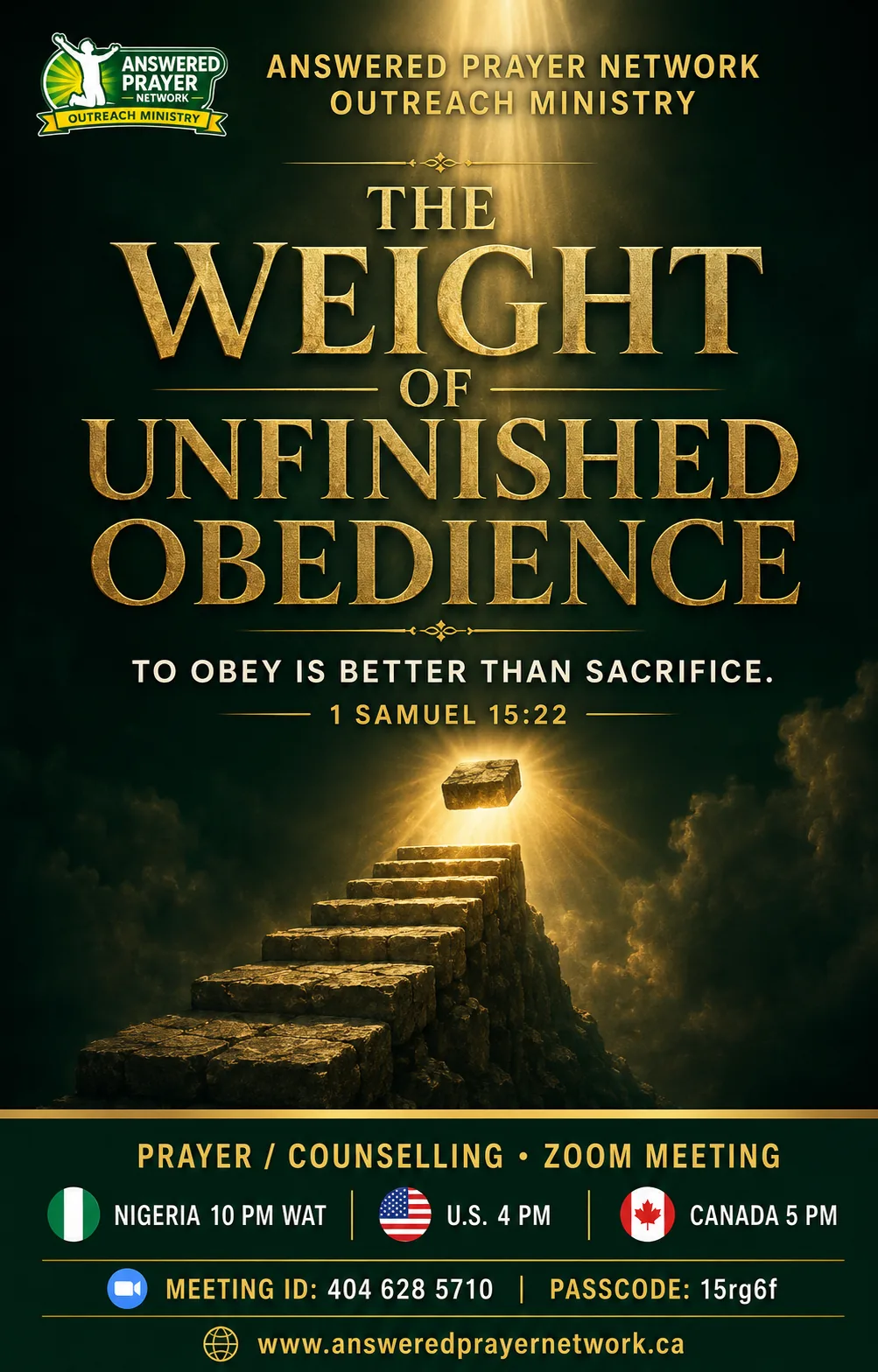
THE WEIGHT OF UNFINISHED OBEDIENCE
Key Scripture
[11] but now you also must complete the doing of it; that as there was a readiness to desire it, so there also may be a completion out of what you have.New King James Version®, Copyright© 1982, Thomas Nelson. All rights reserved.
Daily message / devotional
Obedience is not complete because it was started; obedience is complete only when the instruction of God has been fully carried out. Many believers begin with passion but stop when obedience becomes costly, uncomfortable, or inconvenient. They take the first step but refuse the final one. They surrender what is easy while holding back what is precious. Yet heaven does not measure obedience by our intentions alone—it looks for faithful completion.
Unfinished obedience carries spiritual weight. It lingers in the conscience, interrupts peace, weakens confidence before God, and leaves open what divine instruction was meant to close. The assignment may be postponed, but the responsibility remains. Time does not automatically cancel what God commanded.
The Danger of Partial Obedience
King Saul received a clear instruction from God concerning Amalek, but he carried it out according to his own preference. He destroyed what he considered worthless and preserved King Agag and the best of the livestock. When Samuel confronted him, Saul insisted, “I have performed the commandment of the Lord” (1 Samuel 15:13).
Saul had acted, but he had not obeyed completely.
Partial obedience can be deceptive because it often looks spiritual from the outside. Saul even claimed that the animals had been preserved for sacrifice. He placed a religious explanation over his rebellion, but Samuel declared:
«“Behold, to obey is better than sacrifice, and to hearken than the fat of rams.”
— 1 Samuel 15:22»
God did not ask Saul for an improved plan; He asked for obedience. Saul’s tragedy was not that he did nothing. His tragedy was that he did enough to appear obedient while deliberately withholding the part that challenged him most.
Unfinished obedience frequently protects the very thing God commanded us to surrender. It may preserve an ungodly relationship, a secret habit, dishonest gain, unforgiveness, pride, fear, or personal ambition. Whatever we refuse to place on the altar may eventually become an Agag—something spared today that rises to fight our destiny tomorrow.
When Delay Becomes Disobedience
Not every delay is rebellion. Sometimes God prepares, redirects, or teaches us to wait. But when His instruction is already clear and we continue making excuses, delay becomes disobedience.
We may say, “I will forgive when I am ready.”
“I will answer the call when conditions improve.”
“I will reconcile when the other person apologizes.”
“I will give when I have more.”
“I will surrender after I have enjoyed this season.”
Yet delayed obedience keeps the heart divided. One part desires God’s will, while another part remains committed to personal comfort. The longer obedience is postponed, the heavier the instruction becomes—not because God’s command is evil, but because resistance produces inner conflict.
James 4:17 declares:
“Therefore to him that knoweth to do good, and doeth it not, to him it is sin.”
Knowing creates responsibility. Revelation demands a response. When God has shown us what must be done, continued refusal cannot be hidden beneath prayer, prophecy, fasting, or spiritual activity.
Unfinished Obedience Affects More Than One Person
Obedience is personal, but its consequences are rarely private. Jonah’s refusal to go to Nineveh endangered everyone aboard the ship. Achan’s hidden disobedience affected the entire camp of Israel. Saul’s incomplete obedience weakened his kingdom and altered the future of his household.
Some people connected to us may be waiting on the other side of our obedience. A family may be waiting for our forgiveness. A generation may be waiting for our consecration. A ministry may be waiting for our courage. A wounded soul may be waiting for the testimony we are afraid to share.
When obedience remains unfinished, purpose can be delayed—not because God has lost His power, but because He has chosen to accomplish certain things through human cooperation.
We must never assume that every hardship is caused by disobedience. Faithful people also experience trials. However, when the Holy Spirit repeatedly brings a neglected instruction to our hearts, wisdom demands that we stop blaming the enemy and examine our response to God.
The Exhaustion of Running From God
Unfinished obedience is exhausting. It forces a person to spend strength avoiding what could have been settled through surrender. Jonah slept in the ship, but his sleep was not evidence of peace. A person can be physically resting while spiritually running.
Disobedience creates unnecessary storms within the soul. Prayer becomes difficult because the heart already knows what God has said. New directions seem unclear because the previous instruction remains unanswered. We keep asking God for another word while resisting the word already given.
Sometimes the breakthrough we seek is waiting behind one act of obedience. The next instruction may not come until the previous one has been honoured. God is merciful, but He will not encourage spiritual irresponsibility by continually giving new assignments to a heart determined to abandon old ones.
Obedience Must Survive Inconvenience
True obedience is tested when it becomes costly.
Abraham obeyed when God called him to leave his familiar land. Noah obeyed while building an ark before the rain appeared. Peter obeyed when Jesus told him to cast the net again after a night of failure. Jesus Christ obeyed the Father even unto death on the cross.
Obedience is not proven when the command agrees with our feelings. It is proven when our feelings disagree, yet we still say, “Nevertheless, not my will, but Thine, be done.”
Many assignments begin with excitement but are completed through endurance. Inspiration may begin the journey, but discipline finishes it. The applause may disappear. Supporters may withdraw. Results may seem delayed. Still, obedience must continue because the One who gave the instruction remains faithful.
Grace to Finish
God does not reveal unfinished obedience merely to condemn us. He reveals it so that we may repent, return, and complete what was abandoned. His conviction is an invitation to restoration.
Jonah ran, but God called him again. Peter failed, but Jesus restored him and recommissioned him. John Mark withdrew from a missionary journey, but later became profitable for ministry. Failure does not have to become a permanent identity.
The grace of God does more than forgive our unfinished obedience; it empowers us to finish. Repentance means more than feeling sorry. It means turning around, returning to the place of instruction, and responding differently.
Ask yourself sincerely:
What has God told me to release?
Whom has He told me to forgive?
What assignment have I abandoned?
What promise have I failed to honour?
What habit has He instructed me to confront?
What step of faith have I continued postponing?
The answer may reveal the source of an invisible burden you have been carrying.
Finishing Is an Act of Worship
Jesus did not declare, “It has been started.” He declared, “It is finished” (John 19:30). He completed the work the Father entrusted to Him. His obedience was perfect, costly, and complete.
Likewise, our lives should become offerings of completed obedience. Finishing what God has commanded is an act of worship. It tells heaven that God’s will is more important than our convenience, reputation, fear, or preference.
Do not allow yesterday’s enthusiasm to become today’s abandoned assignment. Do not die carrying instructions that were meant to become testimonies. Return to the altar. Pick up what you dropped. Make the call. Release the offence. Complete the assignment. Honour the promise. Take the step.
The weight of unfinished obedience is lifted when surrender becomes complete.
May the Lord search our hearts and expose every area of delayed, selective, or partial obedience. May He give us courage to complete what we began, humility to correct what we mishandled, and grace to finish every divine assignment entrusted to us.
When our journey on earth is complete, may we be able to say like Paul:
“I have fought a good fight, I have finished my course, I have kept the faith.”
— 2 Timothy 4:7
May we not merely begin with God. May we finish with Him—faithful, surrendered, and fully obedient.