Daily message / devotional
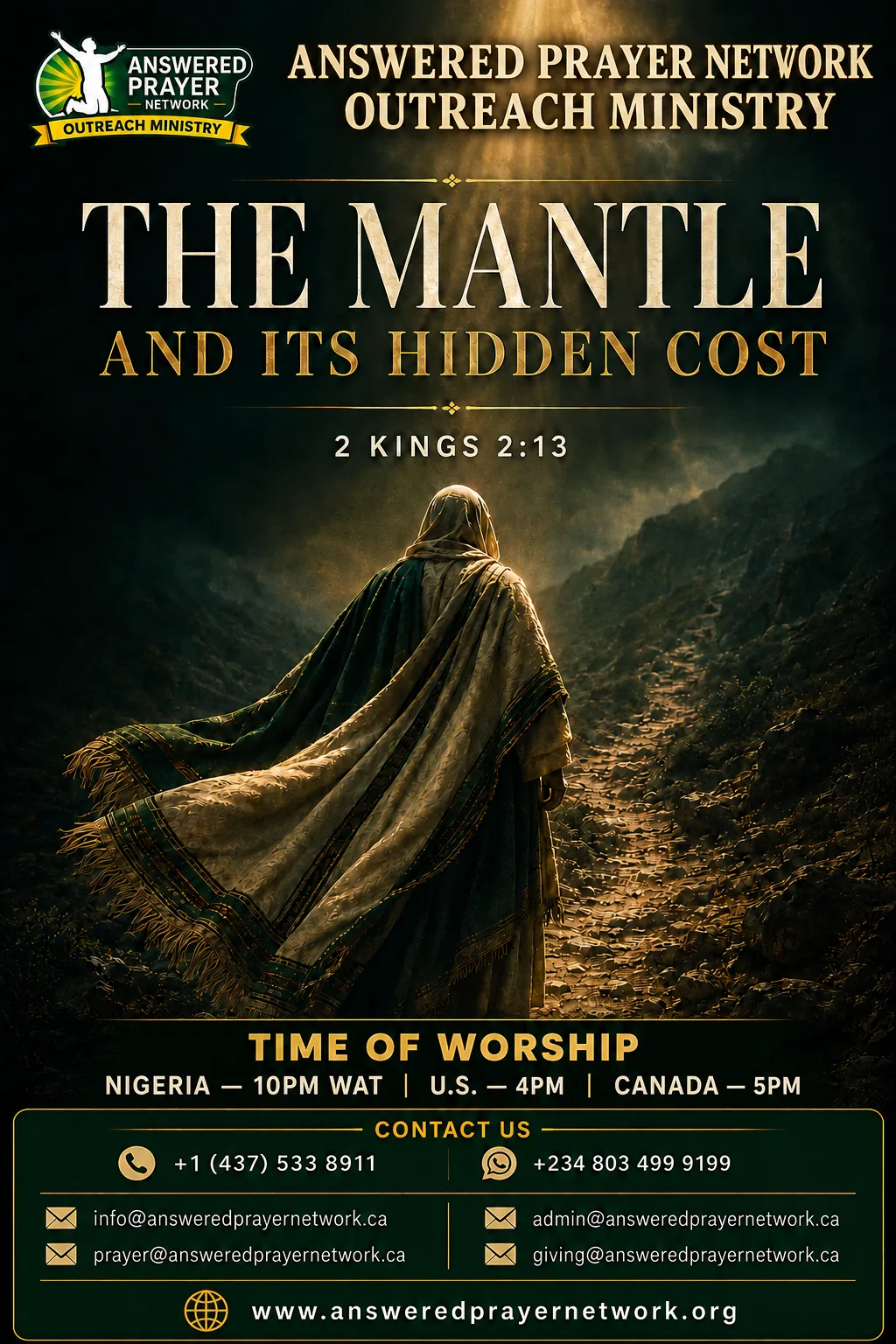
THE MANTLE AND ITS HIDDEN COST
Key Scripture
[13] He also took up the mantle of Elijah that had fallen from him, and went back and stood by the bank of the Jordan.New King James Version®, Copyright© 1982, Thomas Nelson. All rights reserved.
Daily message / devotional
A mantle is not first a garment placed upon the shoulders; it is a divine responsibility laid upon the life. It represents a sacred assignment, spiritual authority, and the grace given by God to accomplish a particular purpose. Many desire the manifestation of the mantle, but few understand the hidden cost of carrying it.
People often celebrate the oil without considering the crushing that produced it. They admire the authority but do not see the years of obedience, separation, warfare, discipline, and surrender behind it. Every genuine mantle has a history written in hidden places—on lonely altars, through unanswered questions, painful seasons, and decisions to obey God when obedience offered no immediate reward.
THE MANTLE IS A CALL TO RESPONSIBILITY
When Elijah cast his mantle upon Elisha, Elisha understood that his former life had come to an end. He left his oxen, surrendered his livelihood, and followed the prophet. The mantle interrupted his comfort and redirected his future.
A genuine calling will often disturb the life you have planned. It may separate you from familiar places, comfortable relationships, and personal ambitions. God does not place a mantle upon a person merely to make that person visible; He places it upon them to make them useful in His hands.
The mantle is not an ornament for public admiration. It is a burden for kingdom service. It is not given to build personal importance but to accomplish divine intention.
THE COST OF PRIVATE PREPARATION
Before Elisha carried Elijah’s mantle publicly, he served him privately. Scripture records that Elisha poured water on the hands of Elijah. Before he commanded kings and performed miracles, he learned humility through service.
Many want the authority of Elisha without submitting to the preparation of Elisha. They desire the double portion but reject the hidden years. Yet God does not entrust lasting spiritual authority to an unprepared character.
The private life of a mantle-bearer must be stronger than the public appearance. Prayer must be deeper than performance. Character must be greater than charisma. Integrity must remain intact when there is no audience, no applause, and no recognition.
The hidden season is not wasted time. It is where God strengthens the vessel so that the weight of the mantle will not destroy the one carrying it.
THE COST OF CONSECRATION
Every mantle demands separation. This does not necessarily mean isolation from people; it means separation from everything that would corrupt the assignment.
Certain things may be permissible for others but dangerous for the one carrying a sacred responsibility. A mantle-bearer cannot live carelessly and expect to function accurately. The anointing is given by grace, but it must be carried with reverence.
Consecration requires discipline over words, desires, relationships, appetites, and decisions. The higher the responsibility, the deeper the accountability.
God will confront everything in the vessel that threatens the purity of the assignment. Pride must die. Selfish ambition must be surrendered. The hunger for approval must be broken. The desire to compete must give way to the willingness to serve.
THE COST OF BEING MISUNDERSTOOD
A divine mantle can make a person difficult for the natural mind to understand. Those who have not heard what you heard may question why you obeyed. Those who have not seen what God showed you may misinterpret your decisions.
Joseph carried a mantle of preservation, but his brothers called him a dreamer and sold him into slavery. Moses carried a mantle of deliverance, yet the people he was sent to rescue frequently criticised him. David was anointed to become king, but before he reached the throne, he was hunted like a criminal.
The mantle does not always attract immediate honour. Sometimes it attracts resistance, jealousy, rejection, and false accusations. The mantle-bearer must therefore learn to receive identity from God rather than from human approval.
If applause becomes your strength, criticism will become your destruction. But when your confidence is rooted in the One who called you, misunderstanding cannot cancel your assignment.
THE COST OF SPIRITUAL WARFARE
Every divine mantle confronts something in the kingdom of darkness. A prophetic mantle confronts deception. A deliverance mantle confronts bondage. A pastoral mantle confronts the forces that seek to scatter the sheep. A mantle of intercession stands in the gap against destruction.
This is why mantle-bearers often experience unusual resistance. The warfare is not always about the individual; sometimes it is directed against what the person carries and the lives connected to that assignment.
However, warfare must never become an excuse for fear or carelessness. It must drive the servant of God deeper into prayer, wisdom, holiness, and dependence upon the Holy Spirit.
The mantle cannot be sustained by talent alone. Yesterday’s encounter cannot carry today’s battle. The altar must remain alive.
THE COST OF CARRYING PEOPLE
A spiritual mantle is never only about the person carrying it. It is connected to families, communities, generations, and destinies.
Moses did not carry only a rod; he carried the cries, complaints, failures, and expectations of an entire nation. Paul described his daily concern for the churches. Jesus was moved with compassion because the people were weary and scattered.
The mantle will cause you to feel burdens that others can easily ignore. It will make you pray for people who may never know the price you paid in prayer. It may require you to stand for those who cannot stand for themselves, encourage the discouraged, restore the broken, and continue serving even when your own heart is tired.
This burden must continually be returned to God. No human being is strong enough to carry people without divine strength. The mantle-bearer must know when to intercede and when to release the outcome into God’s hands.
THE COST OF DYING TO SELF
The deepest cost of the mantle is the death of self.
God must become greater than personal ambition. His glory must become more important than recognition. His will must become more precious than comfort.
A mantle cannot be carried faithfully by someone determined to protect an uncontrolled ego. The vessel must be willing to decrease so that Christ may increase.
This death is not a single emotional experience; it is a daily surrender. It is choosing obedience when rebellion appears easier. It is choosing forgiveness when the wound is deep. It is choosing silence when the flesh wants revenge. It is continuing to serve when no one says thank you.
The mantle becomes dangerous when the person carrying it begins to believe that the power belongs to them. The gift may operate through a person, but the glory belongs entirely to God.
THE MANTLE MUST NEVER REPLACE THE GOD OF THE MANTLE
The greatest danger is becoming more fascinated with the mantle than with the One who gives it.
Power must never replace intimacy. Ministry must never replace relationship with God. Public service must never be allowed to consume the private altar.
Elisha received Elijah’s mantle, but at the Jordan he cried, “Where is the LORD God of Elijah?” His confidence was not merely in the garment; it was in the God whose power rested upon it.
No mantle can function independently of God. Without His presence, it becomes an empty title. Without His character, authority becomes dangerous. Without His wisdom, zeal can produce destruction.
THE COST DOES NOT PURCHASE THE MANTLE
Suffering does not buy the anointing, and sacrifice does not force God to call anyone. The mantle is given by divine grace and sovereign purpose. Yet the person who receives it must be prepared to carry it faithfully.
Not every hardship is proof of a mantle, but every genuine mantle will require surrender. God does not waste pain, delay, service, or hidden seasons. He uses them to purify motives, deepen compassion, strengthen discernment, and teach complete dependence upon Him.
CONCLUSION
The mantle may be seen in public, but its true weight is known in secret. It is carried through prayer when others are sleeping, through obedience when others are compromising, and through faithfulness when there is no visible reward.
Do not desire a mantle merely because you admire its manifestation. Ask God for the grace to carry its responsibility. Ask for the character to protect what He entrusts to you. Ask for the humility to remain at His feet when people begin to honour what He has placed upon your life.
The mantle is costly, but the highest honour is not to be recognised as powerful. The highest honour is to complete the assignment without losing your intimacy with God, your integrity, or your soul.
When the final chapter is written, may it not merely be said that you carried a mantle. May Heaven testify that you carried it faithfully, served your generation humbly, transferred it honourably, and returned all the glory to God.